

September 6, 2018
•
5 min read
Buying Property in Mexico
How do foreigners buy property in Mexico? Complete guide covering legal steps, costs, contracts, and expert tips for expats purchasing Mexican real estate.
Rafael Bracho
Insurance Expert

Have you considered buying property in Mexico? Whether you're dreaming of a beachfront retirement home or looking for an investment property, this guide will walk you through everything you need to know.
This article contains practical advice for the steps to take before you engage in buying property in Mexico, plus helpful tips for how a foreign expat can actually purchase property. Important: WeExpats highly recommends that you review and prepare all contracts with the help of a qualified Mexican attorney—this isn't the place to cut corners.
Understanding Mexico's Property Laws: A Brief History
Here's the thing about buying property in Mexico—you need to understand a bit of history to make sense of why the process works the way it does today.
The Ejido System (1917)
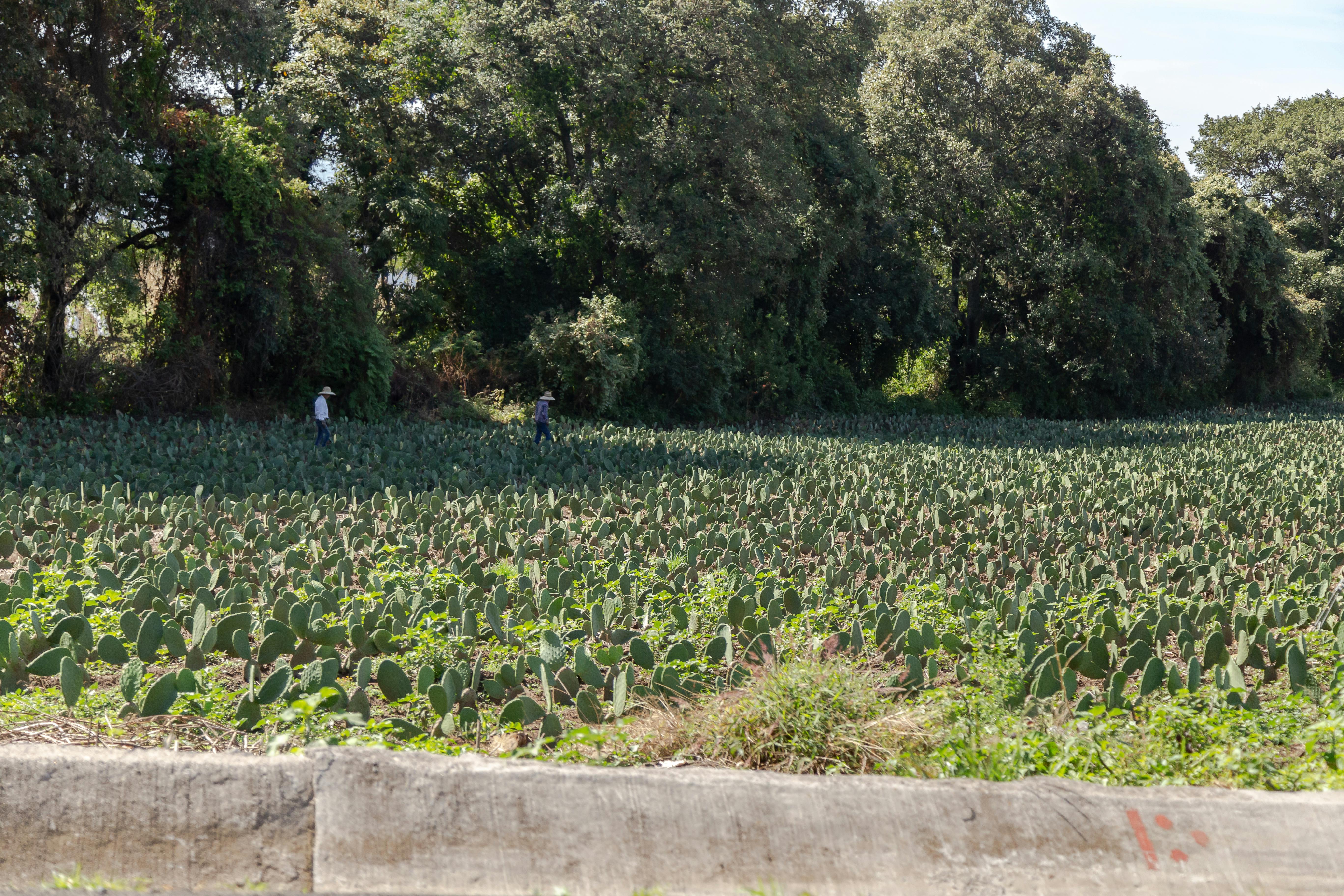
In 1917, Mexico adopted the constitution that still exists today. In this document, the Mexican government decreed that all land would be farmed for agriculture by a community of locals, and thus it would not be private property. This communal land is known in Mexico as "ejido".
Since then, some land has been allocated for private property, however it's still critically important that foreign buyers ensure the land they're interested in purchasing is not ejido. Your attorney will verify this during the title search—but it's worth asking upfront.
The Foreign Investment Law (1973)
In 1973, the Mexican government passed the Foreign Investment Law. This law let foreigners purchase land, except any land within 100 kilometers of a border with another country, or within 50 kilometers of a beach. These are called "restricted zones," and they happen to include most of the places expats actually want to live—beach towns, retirement havens, you name it.
The Fideicomiso Amendment (1993)
In 1993, an amendment to this law was passed so that foreigners could purchase land within these restricted areas through the use of a fideicomiso. This was a game-changer. Suddenly, expats could own beachfront property (sort of—we'll get to that) without becoming Mexican citizens.
What Is a Fideicomiso and How Does It Work?
A fideicomiso is a form of bank trust that allows a Mexican bank to act as an intermediary between you (the foreign buyer) and the property seller. Through this structure, you get all the practical rights of ownership that a Mexican citizen would have—even in restricted zones.
What You Can Do With a Fideicomiso
The beauty of a fideicomiso is that you maintain full control:
- You can will your property to your heirs without hassle
- You can hold several properties under one fideicomiso (though some buyers prefer separate trusts for estate planning)
- You can sell to another foreign buyer simply by changing the name through a process with the Mexican bank—it's actually easier than a traditional property transfer
- LLCs can own fideicomisos, not just individuals, which opens up options for asset protection
Fideicomiso Costs (2025)
Let's talk numbers, because this matters for your budget:
- Setup fee: Roughly $500 USD - $1,000 USD (one-time)
- Annual maintenance fees: Typically $500 - $700 USD per year (paid to the trustee bank)
These fees vary by bank, so shop around. Some banks are more responsive and easier to work with than others—ask other expats for recommendations.
How Long Does a Fideicomiso Last?
Your fideicomiso lasts for 50 years and is renewable. Don't panic about the 50-year limit—renewal is straightforward and relatively inexpensive. Think of it like renewing a very, very long lease.
Understanding Restricted Zones in Mexico
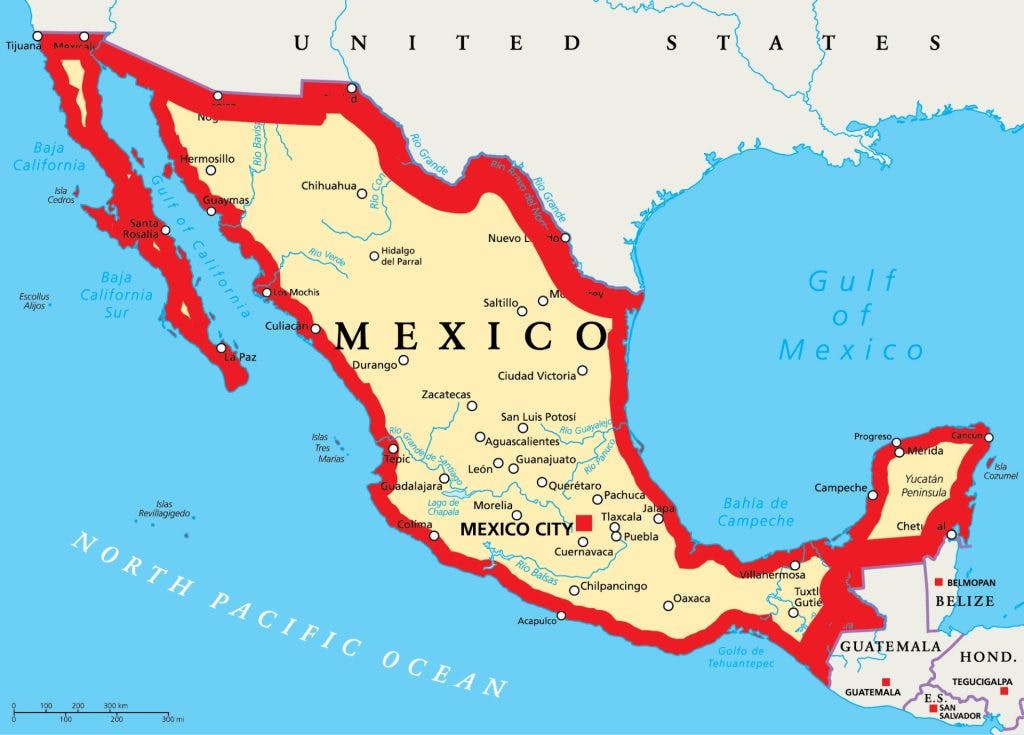
This map shows where you'll need a fideicomiso. Notice how the entire coastline—including popular destinations like Playa del Carmen, Puerto Vallarta, and Cabo San Lucas—falls within the restricted zone. This is why the fideicomiso system is so important for most expat buyers.
Alternative: Buying Through a Mexican Corporation
Starting a corporation in Mexico can also be an avenue for foreign expats, though it's less common for residential buyers. It can often make sense to form a Mexican corporation if you plan to purchase, subdivide, and develop land—or any other process that's business or investment related.
Why You Might Choose a Corporation
- You're developing land for profit
- You're buying commercial property
- You're purchasing outside restricted zones and want direct ownership
- You have complex business structures already in place
Mexican corporations can be owned entirely by foreigners, so that's not a barrier.
The Downsides of the Corporate Route
However, Mexican corporations carry with them more reporting requirements and other restrictions as opposed to a fideicomiso:
Monthly reporting: Mexican corporations require a certified accountant to submit monthly expense and income reports to the Mexican Department of Treasury (Secretaria de Hacienda y Credito Publico – SHCP). This isn't just paperwork—it's an ongoing expense and headache.
Higher taxes: Property held by a Mexican corporation is considered commercial property and is thus susceptible to additional taxes like Value-Added Tax (IVA in Spanish, 16% as of 2025).
Higher costs: Setting up a Mexican corporation must go through a Mexican attorney. Prices vary, but expect at least $50,000 MXN (about $2,600-$2,800 USD as of 2025), plus annual fees to maintain your Mexican corporation (roughly $600 USD - $800 USD).
Bottom line: For most expats buying a home or vacation property, a fideicomiso is simpler and cheaper. Save the corporation route for actual business ventures.
Step-by-Step: The Property Purchase Process
Okay, you've found your dream property. Now what? Here's how the actual purchase unfolds.
Step 1: Making an Official Offer

Though Mexico recognizes verbal agreements, you should always have offers and subsequent contracts in writing. This isn't being paranoid—it's being smart. Make sure terms and conditions are clearly defined.
When you make an offer on a property in Mexico, you and your lawyer will create an official "Offer to Purchase" contract. In this document, you'll detail:
- The purchase price
- How you plan to pay (cash, financing, etc.)
- The earnest money deposit amount
- A deadline for the seller to accept or decline your offer
Pro tip: Don't get emotionally attached during the offer stage. Mexican real estate moves at its own pace, and sellers may counter-offer or take their sweet time responding.
Step 2: The Earnest Money Deposit
If the seller accepts your offer, an earnest money deposit must be drafted by either your attorney or the real estate agent. Be sure to add a clause that guarantees return of the deposit if a final sales agreement or promissory agreement isn't executed within a certain time period.
Define clearly:
- Who receives the deposit (usually held in escrow)
- Under what conditions you get it back
- If the seller requires a non-refundable deposit, make sure it's a smaller amount you can stand to lose if something goes wrong
Earnest deposits in Mexico typically range from 5-10% of the purchase price.
Step 3: The Promissory Agreement (Contrato de Promesa)
After the deposit stage, both parties will draw up a contrato de promesa, or promissory agreement. This document sets the basic terms in place and ensures that both the seller and buyer adhere to a solid timeframe while all remaining paperwork is completed.
Here's what makes this binding: Once the promissory agreement is signed, neither party can back out if all terms and conditions are met. You're committed by Mexican law. So make sure you're really ready before you sign.
Step 4: Behind-the-Scenes Legal Work
After signing the promissory agreement, a lot happens behind the scenes. The seller initiates a trust application with the bank where you'll set up your fideicomiso.
Meanwhile, your attorney gets busy with:
- Ordering a trust permit from the Ministry of Foreign Affairs (Secretaria de Relaciones Exteriores)
- Verifying the seller's right to transfer the title
- Reviewing the title for any issues
- Requesting a certificate of no tax liability from the seller
- Requesting a property appraisal
- Requesting a certificate of no encumbrances (liens, debts, etc.)
- Submitting your identification (passport, proof of address) to the notary public
This is why you hire a good attorney. They're checking that everything is legitimate so you don't end up buying someone else's problems.
Step 5: Finalizing the Purchase Agreement
Once the promissory agreement has been signed and all the paperwork has been completed, the actual purchase/sales agreement (compraventa) is executed.
Around this time, the Ministry of Foreign Affairs will have sent the trust permit to your bank. Your lawyer begins drafting documents to close the deed. Your bank trust officer, attorney, and a public notary will all review the final draft together.
Important note: The notary public (notario publico) in Mexico is not like a notary in the US or Canada. Mexican notarios are highly trained legal professionals—almost like specialized attorneys. They verify everything is legal and proper. Respect their role in this process.
Step 6: The Closing

Once closing paperwork is completed, a closing date is selected. You'll be notified in advance. On closing day:
- The property title is officially transferred to the bank trust (your fideicomiso)
- The final deed is signed
- All final payments and closing costs are due
Then you get the keys. Well, almost—we'll get to that.
What Will This Actually Cost You?
Let's break down all the fees you'll pay as a buyer. These are estimates as of 2025, and they can vary based on property value and location:
Fees You Definitely Pay
- Fideicomiso Permit Fee: ~$1,000 USD (lasts for 50 years)
- Foreign Investment Registration Fee: $300 USD - $800 USD
- Acquisition Tax: 2% of the purchase price (this is big—factor it in!)
- Public Registry Filing Fee: $100 USD - $300 USD
- Notary Public Fees: $650 USD - $1,200 USD (varies by property value)
Fees That Are Negotiable
Some fees can be paid by the buyer or seller, depending on what you negotiate in the contract:
- Appraisal Fee: $300 USD - $500 USD
- Certificate of No Encumbrances: $200 USD - $300 USD
- Real estate agent commissions: Usually paid by seller, but occasionally negotiated
Both buyer and seller are responsible for their own attorney fees, which vary widely. Budget at least $1,500-$3,000 USD for a competent real estate attorney.
Quick math example: On a $200,000 USD property, expect to pay roughly $8,000-$12,000 USD in total closing costs and fees. Plan accordingly.
Getting Your Keys: The Final Step

Once all fees are paid, the notary public will issue a notarized copy of the closing deed. With this document, you now have proof of ownership and can begin setting up utilities and other services for your home.
Within the next few months, the Public Registry (Registro Publico) will issue a final deed containing copies of all certificates and an electronic folio with payment confirmation.
Here's a quirk of Mexican real estate: Taking title and actually being delivered the property are two different processes. They're not necessarily completed on the same day.
The Property Walk-Through
Whether your property has a completed building or not, when you're finally handed the keys, do a thorough personal walk-through. Make sure the property is being passed on in acceptable condition.
You'll be asked to sign a delivery statement. Do not sign it unless you're satisfied that your home, unit, or property is in acceptable condition. This is your leverage—use it.
Popular Mexican Destinations for Expat Property Buyers

While you can buy property throughout Mexico, certain areas are especially popular with expats. All of these require a fideicomiso since they're in coastal restricted zones:
- Playa del Carmen - Caribbean coast, growing expat community
- Puerto Vallarta - Pacific coast, established infrastructure
- Tulum - Bohemian beach town, rising investment market
- Cabo San Lucas - Luxury market, strong rental potential
- Mérida - Colonial city, more affordable (not coastal, so fideicomiso optional)
Can You Do This Remotely?

Here's good news: The process of buying property in Mexico can be handled by your Mexican attorney even if you're not physically in the country throughout the entire process.
You simply have to grant your lawyer power of attorney (poder), and they can handle most of the legwork. You'll likely still want to be present for the final closing and walk-through, but you don't need to be in Mexico for every notary appointment.
Major Mexican Banks That Offer Fideicomiso Services

Choosing your trustee bank is an important decision. The major players include:
- BBVA México - Largest bank, extensive experience
- Santander México - Good expat support
- HSBC México - International presence
- Scotiabank - Strong in certain regions
- Intercam Banco - Specialized in fideicomiso services
Each bank has different fee structures and service levels. Ask other expats in your target area for recommendations.
Final Thoughts and Next Steps

Buying property in Mexico as a foreigner is absolutely doable—over a million expats have done it successfully. The fideicomiso system works well once you understand it, and while there's paperwork involved, it's not insurmountable.
Your action items:
- Find a reputable Mexican real estate attorney before you even make an offer
- Get your finances in order and budget for closing costs
- Verify the property is not ejido land and has clear title
- Choose your trustee bank carefully—ask other expats for recommendations
- Consider property insurance to protect your investment
Ready to take the next step? Get a free insurance quote for your Mexican property, or schedule a phone consultation to discuss your specific situation.
Frequently Asked Questions
Can I get a mortgage in Mexico as a foreigner?
Mexican banks rarely offer mortgages to foreigners, though it's not impossible if you have a Guaranty Trust structure. Most expats either pay cash or get financing in their home country.
What happens if my trustee bank fails?
Your fideicomiso automatically transfers to the successor bank or another institution. Your property rights are protected—you won't lose the property.
Do I pay property taxes in Mexico?
Yes, you'll pay annual property taxes (predial), which are generally much lower than in the US or Canada—often just a few hundred dollars per year.
Can I rent out my Mexican property?
Absolutely. Many expats rent their properties as vacation rentals or long-term leases. Just be aware of tax implications in both Mexico and your home country.
Should I buy in a development or existing property?
Both have pros and cons. Developments may have financing options but carry completion risk. Existing properties let you see exactly what you're getting. Have your attorney review either carefully.
Related Articles:
Rafael Bracho
Insurance Expert & Writer
For several years, Rafael has been crafting articles to help expats and nomads in their journey abroad.
